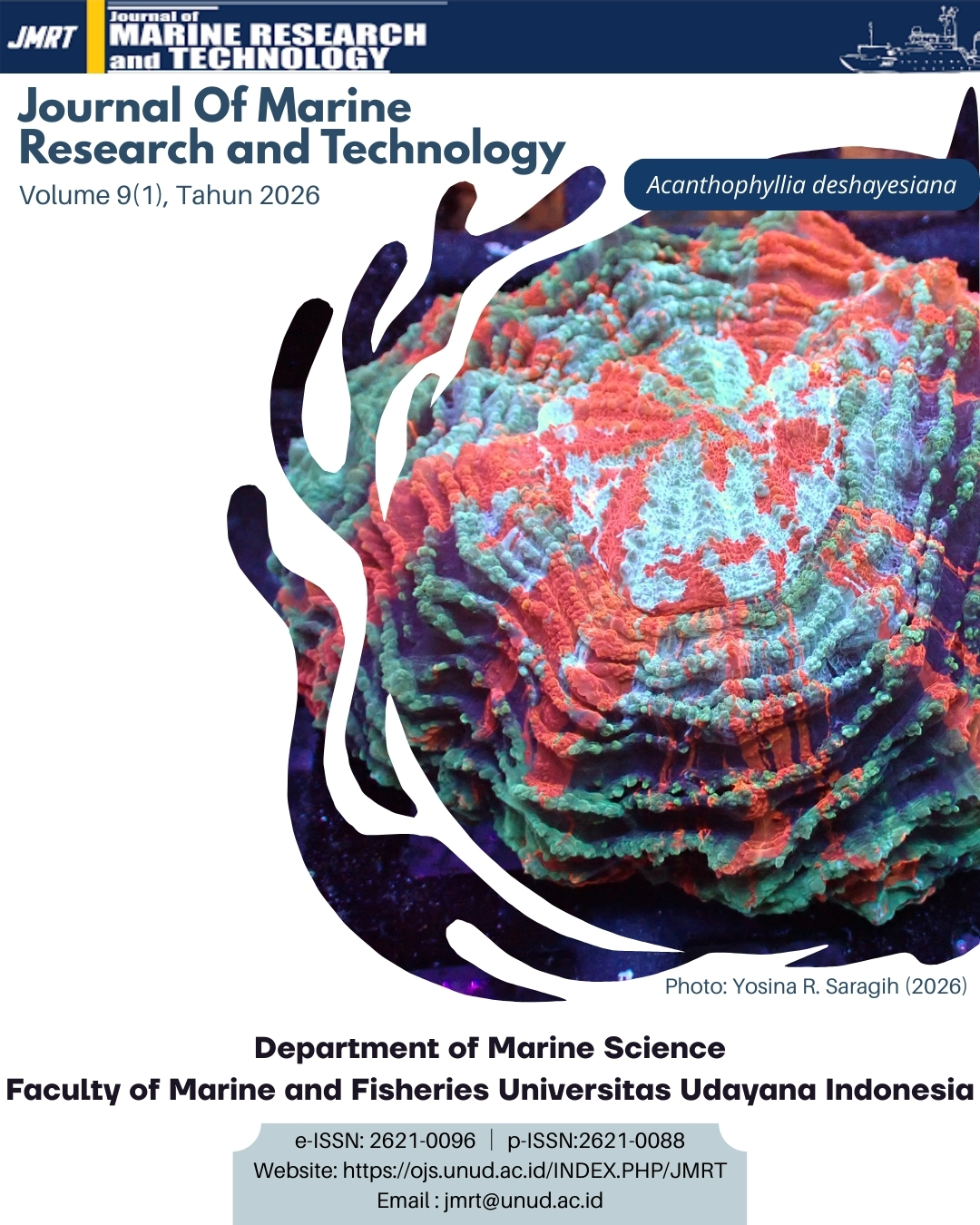
Perbedaan Ukuran Skeleton terhadap Laju Pertumbuhan dan Tingkat Kelangsungan Hidup Karang Acanthophyllia deshayesiana Hasil Fragmentasi di Fasilitas Ex Situ
DOI:
https://doi.org/10.24843/JMRT.2026.v09.i01.p08Keywords:
Acanthophyllia, fragmentation, survival rate, skeleton, growth rateAbstract
Acanthophyllia deshayesiana is a scleractinian coral belonging to the family Lobophylliidae and occurs as a solitary form. This species has considerable economic value and high demand in the export ornamental coral market. However, market supply remains dependent mainly on wild harvest, which poses a risk of long-term depletion of natural coral populations. One potential strategy for the development and conservation of A. deshayesiana is fragmentation; nevertheless, specific and compelling fragmentation protocols for this species remain limited. This study aimed to analyze the effect of coral skeletal size on the growth rate and survival of fragmented A. deshayesiana maintained in an ex situ facility. Fragmentation was conducted based on skeletal size categories: small (<5 cm), medium (7–9 cm), and large (>10 cm). Each size category was represented by three individuals, resulting in a total of nine donor colonies being used for this research. Each skeleton was fragmented into two parts, yielding a total of 16 coral fragments, which were observed over three months. The results indicated that the highest growth rate was observed in the small size category (1.83 cm²), followed by the medium (0.26 cm²) and large (0.21 cm²) categories. The highest survival rate was recorded in the medium-size category (100%), while the small and large categories had survival rates of 66% and 33%, respectively. Although the small-sized skeletons demonstrated the highest growth rate, the medium-sized fragments were considered more stable and adaptive during the maintenance period. Therefore, the medium skeletal size is recommended as the optimal choice for fragmentation practices aimed at conserving and propagating A. deshayesiana.