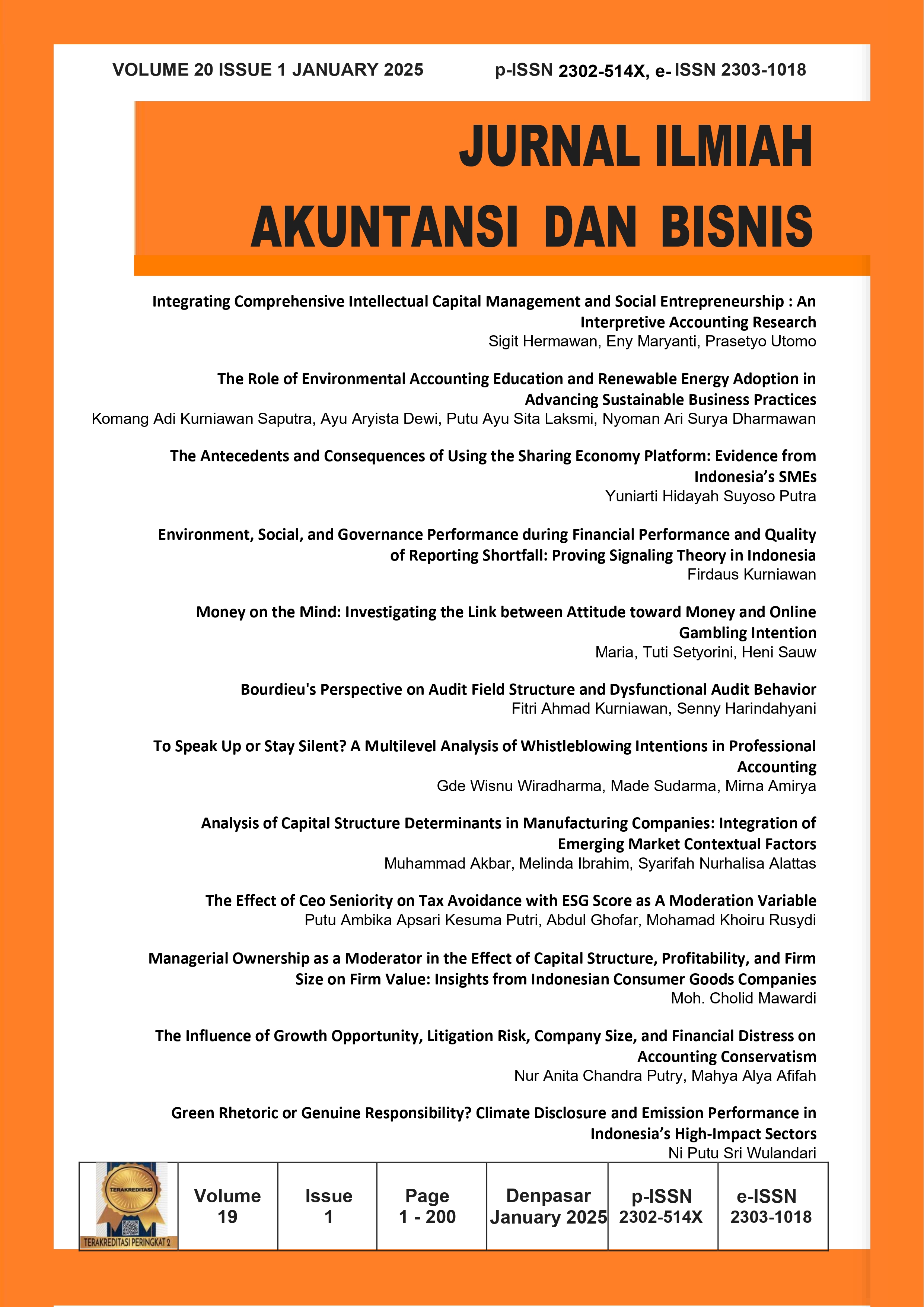
Reconstructing the Audit Field: Bourdieu’s Lens on Structural Dynamics and Dysfunctional Auditor Behaviour
DOI:
https://doi.org/10.24843/JIAB.2025.v20.i01.p03Keywords:
audit, independence, bourdieuAbstract
Audited financial statements are critical to all entities, offering an independent and objective evaluation of organizational performance and financial integrity. In Indonesia, however, the rising demand for audit services has brought audit quality into question. This study explores dysfunctional audit behaviour as a socially embedded practice, applying a dualism framework that synthesizes both subjective and objective dimensions of social reality. Adopting a qualitative approach, the analysis draws on Bourdieu’s theoretical perspective, wherein the social world is shaped by the dialectical relationship between individual agency and structural constraints. The findings indicate that dysfunctional behaviour among public accountants is rooted in the asymmetrical structure of the audit field, wherein auditors’ subjective autonomy and professional independence are frequently at odds with the objective pressures exerted by the field. This misalignment fosters a transition from a logic grounded in cultural capital—such as expertise and ethical commitment—towards a logic dominated by economic capital, thereby eroding professional integrity. The study argues for structural recalibration within the audit field, advocating for state-led interventions informed by Bourdieu’s notion of ontological complicity, to reconcile auditors’ subjective positioning with the objective demands of the field.
Downloads
Published
Issue
Section
License
Copyright (c) 2025 Jurnal Ilmiah Akuntansi dan Bisnis

This work is licensed under a Creative Commons Attribution-NonCommercial-ShareAlike 4.0 International License.