
Input Allocation and Efficiency to Increase Corn Production
DOI:
https://doi.org/10.24843/ijoss.2026.v02.i02.p05Keywords:
Allocative, Economy, Efficiency, Production, TechnicalAbstract
BACKGROUND AND OBJECTIVES
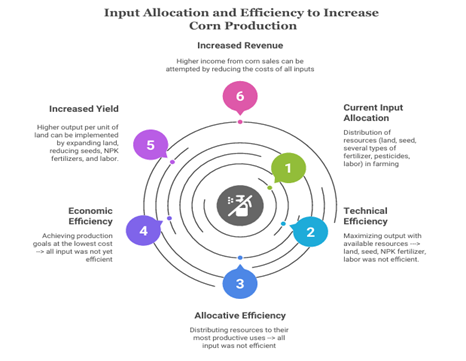
Increasing corn production can currently only be achieved through intensification, where the key is efficiency. Stagnant corn production in the research village over the past three years indicates inefficient use of inputs in corn farming. The first objective of this study is to describe the characteristics of corn farmers. Second, to analyze the allocation of input use by examining the effect of land area, seeds, organic fertilizer, urea fertilizer, phonska fertilizer, NPK fertilizer, pesticides, and labor on corn production. Third, to analyze the technical, allocative, and economic efficiency of input use in corn farming in Dengkol Village.
METHODS
This study conducted in Dengkol Village, Singosari Subdistrict, Malang Regency used quantitative methods. Data were collected through interviews with all 40 corn farmers. This primary data was analyzed using multiple regression with the Cobb Douglas production function approach to identify inputs that significantly affect corn production. Technical, allocative, and economic efficiency were calculated using their respective formulas and the results were then justified according to applicable criteria.
FINDINGS
The results show that only land area and pesticide volume have a significant and positive effect on corn production, while the other six inputs do not. Technical inefficiency stems from the use of land area, seeds, NPK fertilizer, and labor. Meanwhile, the use of all inputs contributes to allocative and economic inefficiency.
CONCLUSION
Corn production can increase if farmers focus on expanding their land and adding pesticides. Farmers should change the combination of inputs that can technically increase production at a lower cost in order to increase their profits. The government and the private sector can facilitate farmers so that their efforts can be achieved. This study is limited to one village and is cross-sectional in nature, so it cannot describe the conditions of villages with different characteristics and the dynamics of change over time.
Downloads
Published
Versions
- 2026-04-18 (2)
- 2026-03-05 (1)