Income and Risks of Melon Farming with a Hydroponics System
DOI:
https://doi.org/10.24843/ijoss.2026.v02.i01.p08Keywords:
Income, Risk, Melon, Hydroponics, FMEAAbstract
BACKGROUND AND OBJECTIVES:
The development of hydroponic cultivation has become an efficient solution to the constraints imposed by limited agricultural land and declining soil quality. Melon farming using this system still faces various production and business risks that can affect income levels. This study aims to analyse income levels and identify the risks associated with hydroponic melon farming at the Experimental Farm of the Faculty of Agriculture, Udayana University (KPFP), Pegok, South Denpasar, Bali.
METHODS:
This study uses a qualitative descriptive approach combined with quantitative income analysis. Primary data were obtained through interviews and documentation of key informants, namely the Head of KPFP and the greenhouse manager. Income analysis was conducted by calculating total costs and total receipts, while risk identification employed Failure Mode and Effects Analysis (FMEA) to assess the severity, occurrence, and detectability of each risk source.
FINDINGS:
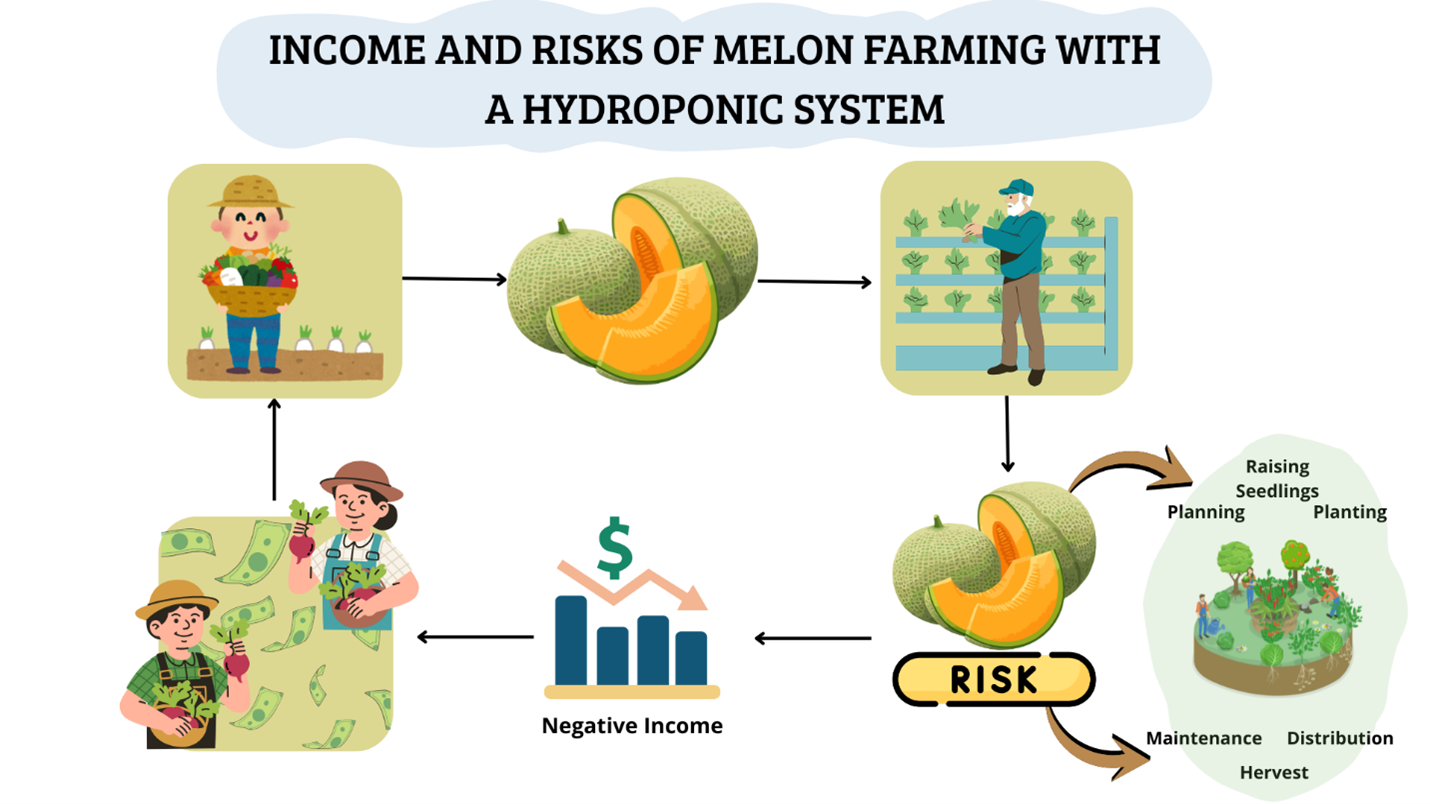
The total production cost of hydroponic melon farming was IDR 40,579,625, with total revenue of IDR 32,280,000, resulting in a net loss of IDR 8,299,625 during the planting period. The main risks identified include pest and disease attacks, nutrient concentration errors, and climate instability in the greenhouse. Based on the FMEA results, production risk has the highest Risk Priority Number (RPN), followed by human resources and market risks.
CONCLUSION:
Hydroponic melon farming at the Experimental Garden of the Faculty of Agriculture, Udayana University, has not yet achieved financial viability due to high investment and operational costs. Effective risk management strategies, such as improved pest control, routine nutrient monitoring, and worker training, are needed to minimise the risk of production failure. This study contributes to the development of a sustainable hydroponic agribusiness model in an educational and research environment.