
Economic Feasibility Assessment of Robusta Coffee Farming
DOI:
https://doi.org/10.24843/ijoss.2026.v02.i01.p05Keywords:
Robusta coffee farming, Economic analysis, Profitability, Revenue Cost Ratio, Business feasibility, Plantation agribusiness, Financial performance, Input management , Smallholders, Agricultural productivityAbstract
BACKGROUND AND OBJECTIVES
The robusta coffee farming sector in Semarang Regency, Central Java, plays a crucial role in the local economy, providing employment opportunities and contributing to regional agricultural production. Despite favourable agroecological conditions, the productivity and profits of coffee cultivation in the region vary significantly due to differences in cultivation methods. This study aims to evaluate the economic performance of robusta coffee cultivation in Semarang Regenc y, focusing on farmers' income, profi ts, and financial feasibility through key indicators such as Cost Income Ratio (R/C) and Cost Benefit Ratio (B/C).
METHODS
This study employed a quantitative descriptive approach, conducting structured interviews with 69 randomly selected coffee farmers from the districts of Getasan, Bandungan, and Banyubiru. Primary data on production costs, crop yields, selling prices, and income components were collected, supplemented by secondary data from local agricultural offices. The financial feasibility of coffee cultivation is evaluated using R/C and B/C ratios to determine profitability and efficiency.
FINDINGS
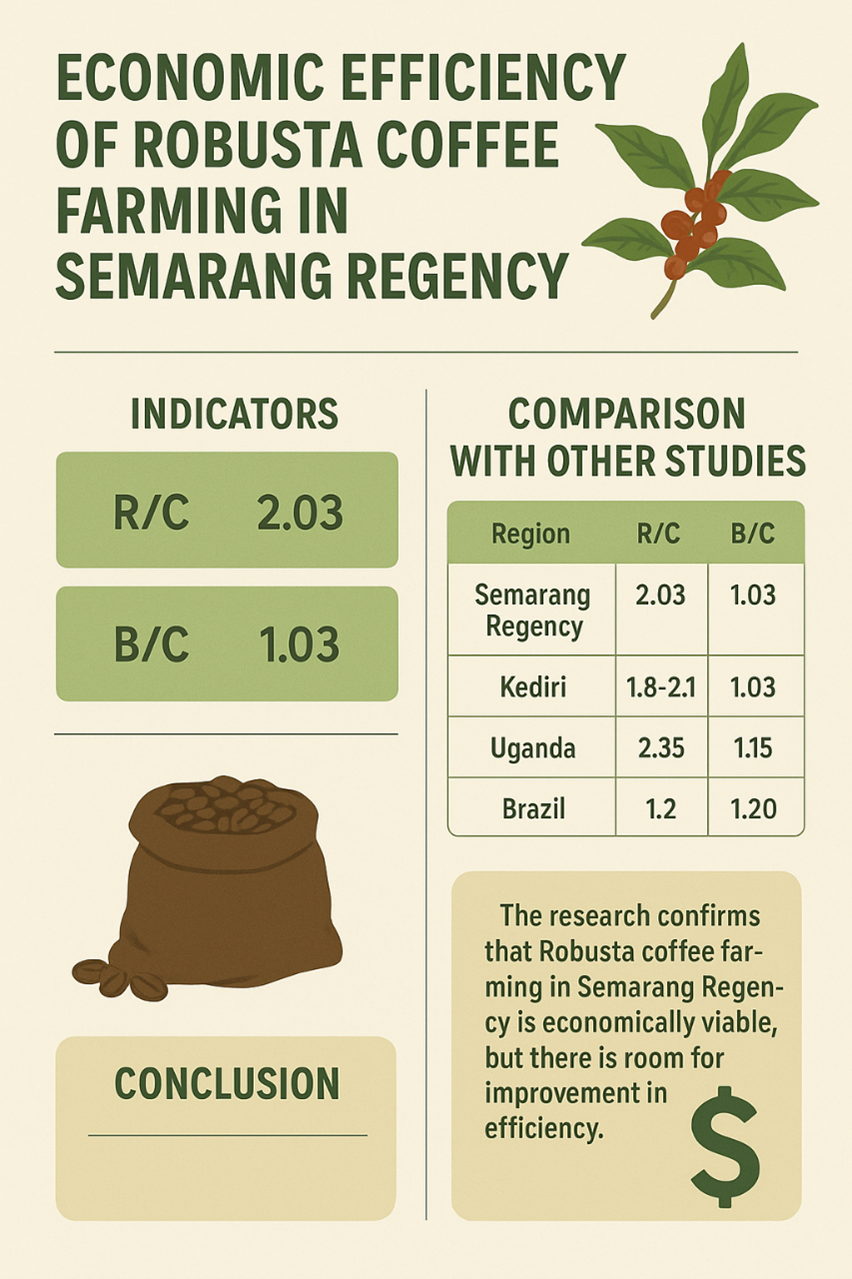
The study found that the average productivity of robusta coffee was 914.7 kg per hectare, with an average selling price of IDR 24,372 per kg. The average income per hectare after deducting variable costs was IDR 13.33 million, with a net profit of IDR 11.30 million per hectare. An R/C ratio of 2.03 indicates that this farming venture is profitable, and a B/C ratio of 1.03 confirms the economic viability of coffee cultivation in the region.
CONCLUSION
The results of the study indicate that robusta coffee cultivation in Semarang Regency remains economically viable and profitable, with efficient production management practices contributing to positive financial outcomes. However, variations in productivity and input management efficiency among farmers pose challenges in maximising profits. Recommendations include enhancing cultivation practices, expanding market access, and stabilising coffee prices to ensure long-term sustainability. This research contributes to the understanding of the economic potential of coffee cultivation and provides practical insights to improve farmers' income and cultivation efficiency.
Downloads
Published
Versions
- 2025-12-11 (3)
- 2025-12-11 (2)
- 2025-12-09 (1)