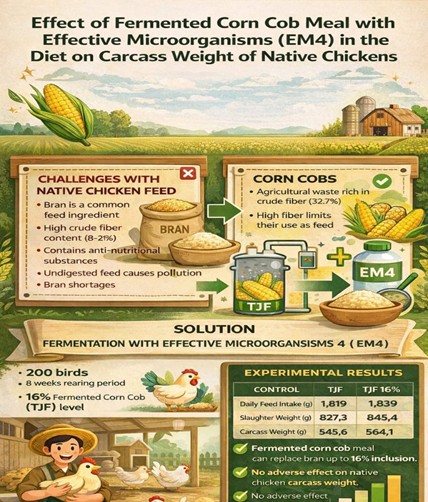
Effect Of Fermented Corn Cob Meal With Effective Microorganisms (Em4) In The Diet On Carcass Weight Of Native Chickens
DOI:
https://doi.org/10.24843/ijoss.2026.v02.i02.p01Keywords:
Carcas Weight, Corn Cob, EM4, Fermented, Native ChickenAbstract
BACKGROUND AND OBJECTIVES
Local chicken production has significant economic potential; however, its development is constrained by low productivity and inadequate feed quality. Native chicken farming plays an important role in supporting the livelihoods of small-scale farmers, yet productivity remains limited due to dependence on conventional feed ingredients such as rice bran, whose availability and quality are often inconsistent. The utilization of agricultural by-products as alternative feed ingredients represents an innovative approach to improving efficiency and sustainability in native chicken production systems. Corncob is an abundant agricultural residue, but its utilization is limited by high crude fiber content and low nutrient digestibility. Fermentation using Effective Microorganisms (EM4) has the potential to enhance the nutritional quality of corncobs, making them more suitable for use as a feed ingredient. This study aimed to evaluate the use of EM4-fermented corncob meal as a substitute for rice bran in native chicken diets and to assess its effects on feed intake, slaughter weight, carcass weight, and carcass percentage. The findings of this study are expected to contribute scientific insights into the development of sustainable, agricultural waste-based alternative feeds that are practical and applicable for small-scale native chicken farming systems.
METHODS
The study was conducted at the Livestock Production and Forage Laboratory, Faculty of Animal Science, University of Jambi, for a period of eight weeks using 200 day-old native chickens. The experiment employed a Completely Randomized Design (CRD) with five dietary treatments and four replications. The treatments consisted of different inclusion levels of fermented corncob meal (FCM) in the diet, namely P0 = 0%, P1 = 4%, P2 = 8%, P3 = 12%, and P4 = 16%. The observed parameters included feed intake, slaughter weight, absolute carcass weight, and relative carcass weight. Data were analyzed using analysis of variance (ANOVA), and when a significant effect was detected (P < 0.05), Duncan’s Multiple Range Test was applied for mean comparison.
FINDINGS
The results of this study indicate that corncob meal fermented using EM4 can be utilized as a substitute for rice bran in native chicken diets. The inclusion of this feed ingredient allows normal feed intake to be maintained and is able to sustain slaughter weight and carcass weight of native chickens.
CONCLUSION
It can be concluded that fermented corncob meal can be included at levels up to 16% in native chicken diets without adversely affecting production performance.