Luwak Coffee Agrotourism Development Strategy
DOI:
https://doi.org/10.24843/ijoss.2026.v02.i02.p03Keywords:
Agrotourism, Luwak Coffee, Sustainable, SWOT, TourismAbstract
BACKGROUND AND OBJECTIVES
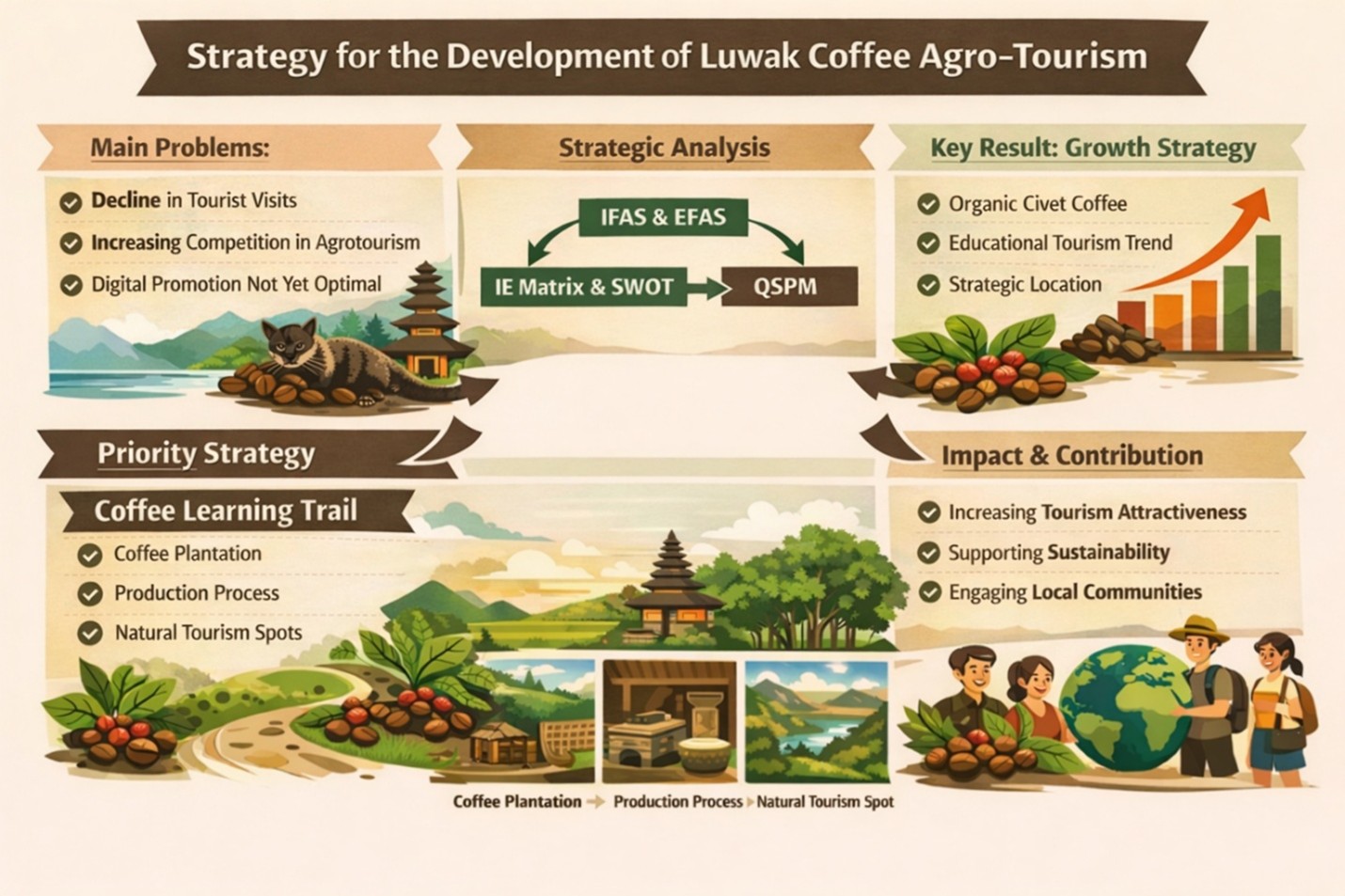
Bali tourism that relies on the advantages of nature, culture, and community participation continues to develop through the diversification of education-based and sustainability-based products, including civet coffee agrotourism in Tegallalang District, Gianyar. Bali Nature Luwak Coffee Agrotourism in Sebatu Village faces challenges in the form of fluctuations in visits, changes in tourist preferences, as well as the need to strengthen competitiveness and sustainable management so that it is necessary to formulate a directed development strategy based on comprehensive analysis.
METHODS
A qualitative descriptive approach was used, with data collected through observation, interviews, documentation, and questionnaires. The analysis uses IFAS, EFAS, IE Matrix, SWOT, and QSPM to identify internal and external factors and determine strategic priorities to increase the competitiveness and sustainability of civet coffee agrotourism.
FINDINGS
The results of the study show that agro-tourism sites have strengths such as unique coffee products and strategic locations, but face weaknesses in the quality of facilities and digital promotion. Opportunities include increased interest in educational and sustainable tourism, while threats involve competition and changes in tourist behavior. The recommended strategy emphasizes improving service quality, improving digital marketing, and building partnerships with external stakeholders. This research provides a practical framework for sustainable.
CONCLUSION
The main findings from the analysis results through IFAS, EFAS, IE Matrix, SWOT, and QSPM show that the Bali-based Luwak Alam Coffee Agrotourism has the main strength in the form of the uniqueness of coffee products and its strategic location. Contributions in this research can make a positive contribution in the field of agro-tourism development to make Bali's Alam Luwak Coffee agrotourism remain competitive and sustainable. The limitations in this study are the lack of operational evaluation through facility improvements, addition of product variety, and the development of strategies to overcome the decline in visits. Thus, recommendations are needed in the form of improving agro-tourism management and stakeholders in formulating a competitive agro-tourism development strategy.