Post Harvest Added Value of Arabica Coffee and Its Determining Factors
DOI:
https://doi.org/10.24843/ijoss.2026.v02.i02.p02Keywords:
Kopi arabika, Nilai tambah, Natural, Semi washed, Full washed, Added value, Arabica coffee, Fully washed, Semi-washedAbstract
BACKGROUND AND OBJECTIVES
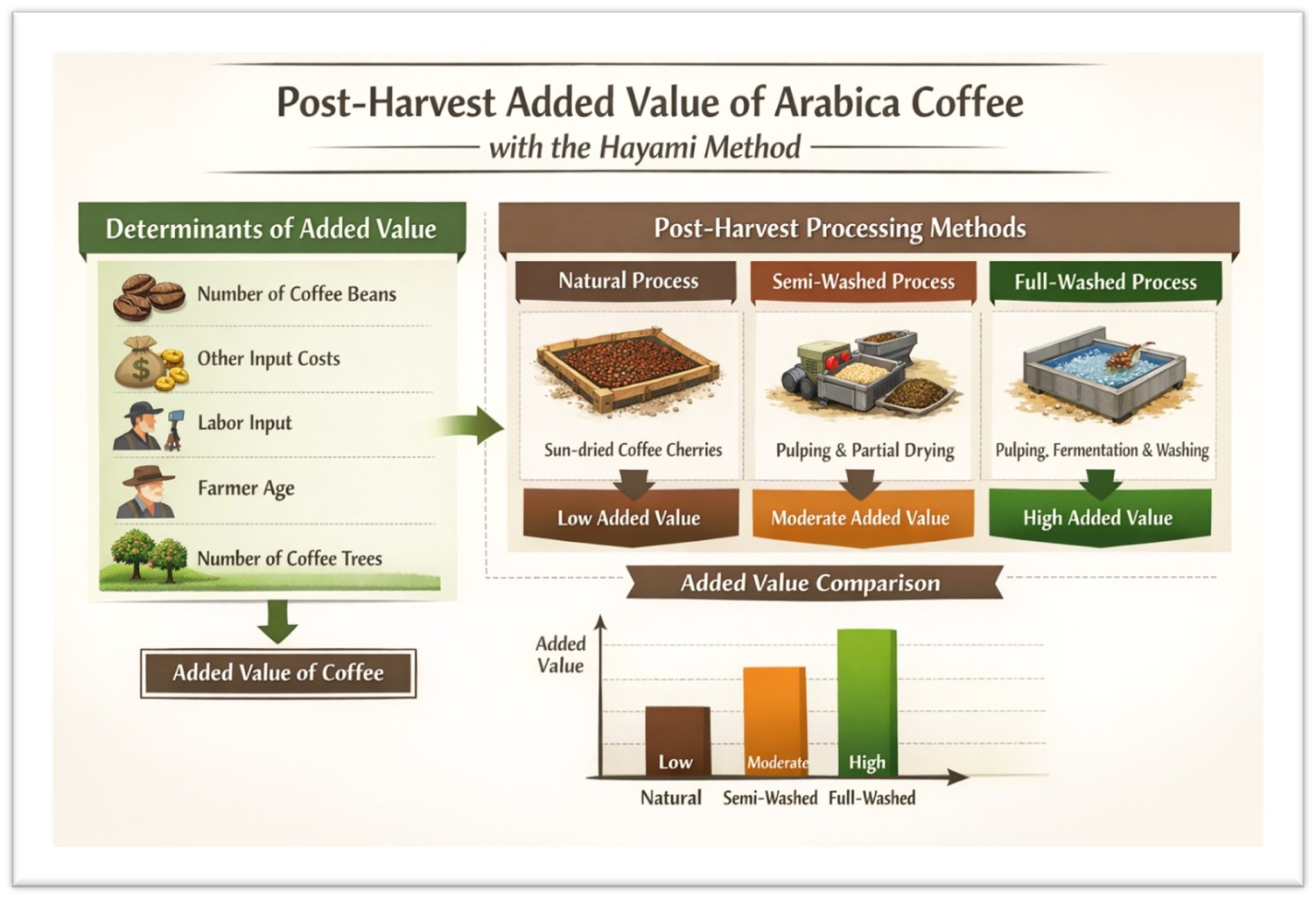
Farmers in Bulukerto Village generally sell their coffee in red or semi-dried pods to middlemen. As a result, they receive a much lower price than if they sold it as green or roasted beans. Farmers also lack understanding of standard post-harvest processing techniques and have not optimally utilized coffee processing tools and machinery. Low selling price, limited post-harvest knowledge, dependence on middlemen, and minimal use of technology are the main challenges faced by coffee farmers. The added value of coffee products is largely determined by post-harvest processing, whether through dry (natural) or wet (semi-washed and full-washed) processing. This study aims to analyze the added value and yield of Arabica coffee in Rekesan, Bulukerto Village, Batu City, East Java, and identify the determining factors.
METHODS:
Data were collected from all Arabica coffee farmers belonging to a forest farmer group in Bulukerto Village, who implemented three post-harvest handling methods for harvested coffee beans. The population consisted of 20 farmers. Coffee bean yield was calculated using the applicable standard formula, and the added value of coffee beans was analyzed using the Hayami method. Meanwhile, factors influencing added value through the Cobb-Douglas production function approach were analyzed using a multiple linear regression model.
FINDINGS:
The study revealed that coffee bean yield and added value varied depending on the post-harvest handling methods employed by farmers. The highest yield and added value were achieved through the natural method. Factors influencing added value also varied depending on the post-harvest handling practices employed by farmers. The number of coffee beans significantly influenced added value, although the relationship was different for the full washed method.
CONCLUSION:
Natural post-harvest handling produces high yields and added value, but is less popular with consumers. Therefore, an in-depth study of consumer preferences for these coffee beans is necessary. The full washed method requires significantly more labor, but this factor does not significantly impact added value. A limitation of this study is that it does not differentiate coffee beans by plant age, so future researchers could explore this factor