
Income, Welfare, and Food Security of Coffee Farmer Households
DOI:
https://doi.org/10.24843/ijoss.2025.v01.i01.p03Keywords:
Income, Welfare, Food, Farmer, CoffeeAbstract
BACKGROUND AND OBJECTIVES:
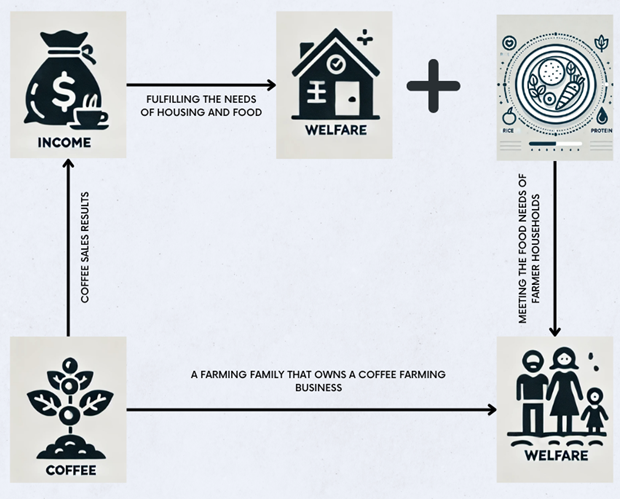
Belatungan Village in Pupuan Subdistrict, Tabanan Regency, has great potential in coffee production. However, its farmers face challenges such as fluctuating selling prices, limited market access, and high production costs. This has an impact on household income, welfare, and food security. This study aims to assess the income of coffee farmers, evaluate their food security, and assess their overall welfare condition
METHODS:
This study used a descriptive quantitative method. Data were collected through questionnaires and structured interviews with 49 farmers from two farmer groups, selected using the census method. Primary data was obtained directly from respondents, while secondary data came from written documents and references. Data analysis included: (1) net income calculation, (2) welfare assessment based on rice equivalent consumption, and (3) food security measurement through the proportion of household food expenditure
FINDINGS:
The average annual income of coffee farmers is IDR 73,46 million, or approximately IDR 6.12 million per month. Household welfare is considered good, as indicated by an average rice consumption equivalent to 1,440 kg per person per year. A total of 83.67% of households are classified as food secure, as their food expenditure accounts for less than 60% of total household spending. However, 16.33% of households remain classified as food insecure.
CONCLUSION:
Coffee cultivation significantly contributes to farmers' income, welfare, and food security in Belatungan Village. However, some farmers remain economically vulnerable. Strategies such as improving market access, enhancing production efficiency, and providing training on business diversification are essential. This research offers empirical insights into the linkages between income, welfare, and food security, highlighting the need for sustainable and targeted policy interventions. The main limitation of this study lies in its relatively narrow scope; therefore, further research with a broader and more in-depth approach is necessary to obtain a more comprehensive understanding.
Downloads
Published
Versions
- 2025-08-23 (3)
- 2025-08-23 (2)
- 2025-07-10 (1)