Publication Ethics
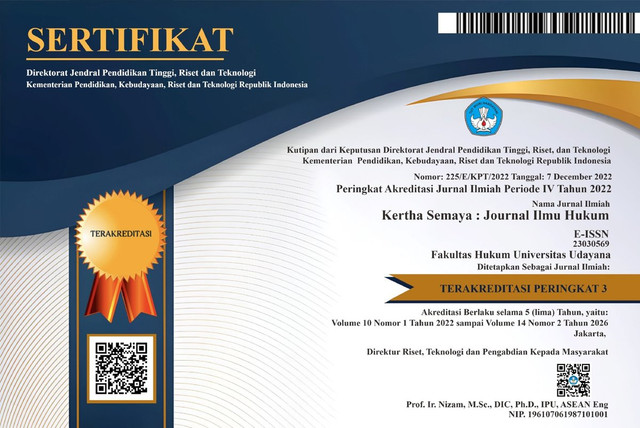
Kertha Semaya: Journal Ilmu Hukum has been published electronically as an Open Journal System (OJS) since December 2012 by the Faculty of Law, Udayana University, under E-ISSN 2303-0569. Article publication strictly adheres to established Publication Ethics.
Open Access Policy & Ethics
As an electronic Open Access Journal, articles published in this journal are freely accessible to readers. Ethically, this open-access policy is intended to support the global dissemination of knowledge, specifically concerning legal research findings across local, national, and international domains in accordance with the journal's focus and scope.
Publication Frequency
The journal is published regularly on a monthly basis (12 issues per year).
Publication Ethics for the Board of Editors
The publication of articles in this journal undergoes a Peer-Review Process, which begins with an initial screening and template review by the Board of Editors as follows:
-
Board of Editors: Acts as journal managers (editors) responsible for carefully examining and ensuring that submitted articles strictly comply with the Author Guidelines and Journal Template.
-
Managing Editor: Responsible for returning manuscripts to authors if they fail to meet the Author Guidelines, Journal Template, or publication ethics standards based on the editorial evaluation.
-
Similarity Screening: Text similarity checks using Turnitin are conducted during the editorial review process to evaluate originality.
-
Final Decisions: Journal Editors are responsible for deciding which articles are suitable for publication, considering the initial editorial evaluation, reviewer feedback validity, and the article's scholarly contribution to legal science for researchers, academics, and practitioners across local, national, and international contexts.
Publication Ethics for Reviewers
All articles published in this journal undergo a peer-review process conducted by qualified reviewers. Reviewers are tasked with evaluating the manuscript's substance and assisting authors through constructive feedback regarding the state of the art and other relevant substantive components. Reviewers must conduct reviews ethically and objectively, providing clear evaluations, insights, and suggestions supported by explicit academic arguments.
Personal criticism directed at authors is unethical and strictly inappropriate during the peer-review process.
Reviewers must thoroughly evaluate and identify the relevance of legal documents, concepts, theories, and previous literature used by the author for analysis. Reviewers must decline reviewing manuscripts if a conflict of interest exists with the authors. Furthermore, reviewers must not use unpublished manuscript content for their own research or personal gain.
Publication Ethics for Authors
Authors seeking to publish in this journal must follow the requirements specified in the Author Guidelines and Journal Template. Authors are required to present their research methodology clearly and accurately in accordance with established standards in legal research. All data presented in tables or figures must cite their original sources. Data fabrication, falsification, or dishonest referencing constitutes unethical behavior that will not be tolerated.
Originality is verified through Turnitin similarity screening. Authors using prior research to support their work must properly acknowledge and cite all sources using standard footnote mechanisms. Simultaneous submission of the same manuscript to multiple journals or submitting previously published work is unethical and strictly prohibited.
Authorship credit must be limited strictly to individuals who contributed significantly to the research and preparation of the manuscript. Listing individuals who made no contribution to the work is unethical and unacceptable.


 View My Stats