About the Journal

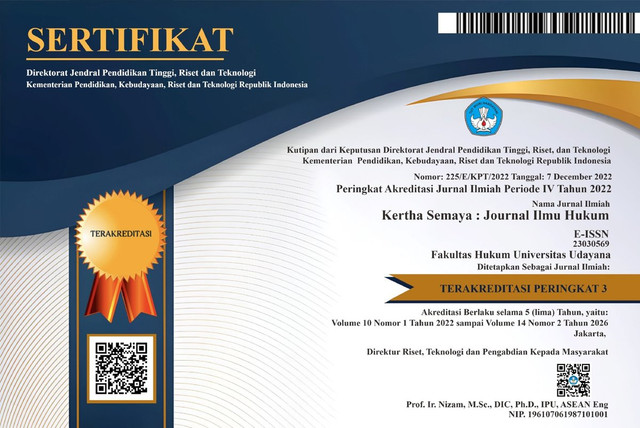
Kertha Semaya Journal was first published electronically using Open Journal Systems (OJS) in December 2012 by the Faculty of Law, Udayana University, with Online ISSN 2303-0569. Since November 11, 2019, Kertha Semaya Journal has been accredited by Sinta Dikti (Sinta Rank 3) based on the Decree of the Director General of Research and Development Strengthening, Ministry of Research, Technology and Higher Education of the Republic of Indonesia, Decree No. 225/E/KPT/2022 dated December 7, 2022, concerning Scientific Journal Accreditation Ranking Period IV of 2022.
Kertha Semaya Journal is published to facilitate the mandatory journal publication requirements for law students at Udayana University. To continuously improve journal management, the editorial team ongoingly enhances administrative and governance management, such as expanding the Editorial Board and Reviewer list, as well as improving article substance through Turnitin similarity checking.
Kertha Semaya Journal is an Open Journal Systems (OJS)-based journal published monthly. All published articles undergo a peer-review process, starting with an initial evaluation by the Board of Editors followed by a review process by the reviewer team.
Article publication in this journal involves a peer-review process beginning with an evaluation of the manuscript and journal template compliance by the Board of Editors—comprising editors with proven track records in journal management—who carefully examine and ensure that submitted articles meet the Author Guidelines and Journal Template.
As part of the Editorial Team's evaluation, a similarity check using Turnitin is also conducted on the manuscript submitted by the author, reflecting the author's academic integrity, morality, honesty, and responsibility to ensure the submitted work shows no indication of plagiarism. The maximum allowable similarity threshold is 20%.
Authors submitting articles to Kertha Semaya Journal must comply with the Author Guidelines, format their work according to the Journal Template, and adhere to Publication Ethics.
The objective of this journal is to provide a platform for publishing critical thinking derived from original research, conceptual ideas, and review articles from academics, researchers, and practitioners that have not been published in other media. The Scope & Focus of published articles includes the following topics:
- Civil Law
- Constitutional Law
- Administrative Law
- Criminal Law
- International Law
- Procedural Law
- Customary Law
- Business Law
- Tourism Law
- Environmental Law
- Law and Society
- Information Technology and Electronic Transactions Law
- Human Rights Law
- Contemporary Law


 View My Stats