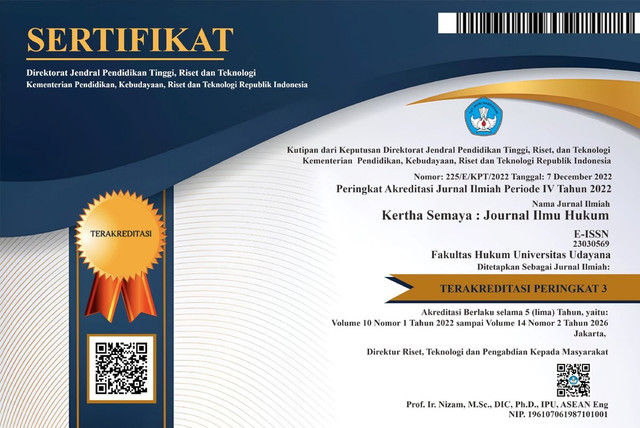
PELANGGARAN KONTRAKTUAL E-COMMERCE: BAGAIMANA PENGEMASAN ULANG TANPA IZIN MENGANCAM KEASLIAN DAN KEAMANAN PRODUK KONSUMEN?
DOI:
https://doi.org/10.24843/KS.2026.v14.i07.p06Keywords:
Wanprestasi, Perdagangan Elektronik, Perlindungan Konsumen, Orisinalitas ProdukAbstract
Penelitian ini bertujuan untuk menganalisis kualifikasi yuridis perbuatan wanprestasi dalam perjanjian jual beli online berdasarkan Kitab Undang-Undang Hukum Perdata (KUH Perdata) dan Undang-Undang Nomor 8 Tahun 1999 tentang Perlindungan Konsumen (UUPK), serta membedah dasar pertimbangan hukum Majelis Hakim dalam Putusan Pengadilan Negeri Klaten Nomor 105/Pdt.G/2022/PN Kln ditinjau dari aspek jaminan keamanan dan orisinalitas produk bagi konsumen akhir. Metode penelitian yang digunakan adalah penelitian hukum normatif dengan pendekatan perundang-undangan, pendekatan kasus, dan pendekatan konseptual, di mana teknik analisis data dilakukan secara kualitatif normatif dengan metode berpikir deduktif. Hasil penelitian menunjukkan bahwa tindakan pengemasan ulang dan pengisian ulang sepihak oleh pelaku usaha pengecer dikualifikasikan sebagai wanprestasi berdasarkan Pasal 1243 KUH Perdata karena melanggar kewajiban kontrak untuk menjaga mutu dan integritas objek perjanjian, serta mencederai asas itikad baik dalam pelaksanaan kontrak sebagaimana diatur dalam Pasal 1338 ayat (3) KUH Perdata. Selain itu, Majelis Hakim PN Klaten dalam pertimbangan hukumnya secara progresif menyelaraskan perlindungan kontrak komersial dengan aspek perlindungan konsumen dengan menegaskan bahwa pembukaan segel asli tanpa otoritas resmi menghilangkan jaminan mutu produsen, sehingga secara nyata melanggar hak konsumen atas informasi yang jujur serta hak atas keamanan dan keselamatan konsumsi produk sesuai Pasal 4 dan Pasal 7 UUPK. Putusan ini memberikan implikasi penting terhadap standardisasi klausula kontrak digital, penyederhanaan beban pembuktian sengketa siber, serta penguatan etika kepatuhan platform pasar dalam menjaga kepercayaan konsumen di pasar digital.
This study aims to analyze the legal qualification of default in online sales contracts under the Indonesian Civil Code (Burgerlijk Wetboek) and Law Number 8 of 1999 concerning Consumer Protection (UUPK), as well as to examine the legal reasoning (ratio decidendi) of the Panel of Judges in the Klaten District Court Decision Number 105/Pdt.G/2022/PN Kln, specifically regarding the safety and authenticity guarantees of products for final consumers. This study employs a normative legal research methodology utilizing a statute approach, a case approach, and a conceptual approach, with a qualitative normative data analysis using deductive reasoning. The research findings reveal that unauthorized repacking and refilling actions by a reseller are qualified as a breach of contract (default) under Article 1243 of the Indonesian Civil Code, as they violate the contractual obligation to maintain the quality and integrity of the agreed object, thereby breaching the principle of good faith in contract performance as mandated by Article 1338 paragraph (3) of the Civil Code. Furthermore, the judges of the Klaten District Court in their legal considerations progressively harmonized commercial contract enforcement with consumer protection principles by asserting that tampering with the original factory seal without authorization effectively voids the manufacturer's quality control, which directly violates the consumer's right to honest information, safety, and security as stipulated under Article 4 and Article 7 of the Consumer Protection Act. This landmark decision carries significant implications for the standardization of digital contract clauses, the simplification of the burden of proof in cyber disputes, and the enforcement of platform compliance to foster consumer trust within the digital marketplace.
Downloads
Published
Issue
Section
License
Copyright (c) 2026 Daven Nathanael, Amad Sudiro

This work is licensed under a Creative Commons Attribution-NonCommercial-ShareAlike 4.0 International License.